20+ years focused on cosmetic bags

 FUYUAN
  2026-06-24


By Steven Yuan, FUYUAN BAG FACTORY | Updated: May 15, 2026

Most beauty brands we talk with have already searched "how cosmetic bags are made" before sending their first inquiry. They have a design idea, a budget range, and a rough launch timeline — but very little visibility into what actually happens inside a custom cosmetic bag factory between the day they place an order and the day a sea container arrives at their warehouse.
That information gap is where most sourcing mistakes are born. A pattern that looks fine on a tech-pack can be impossible to cut economically. A lining that looks premium in a swatch book may delaminate after 6 months on a retail shelf. A "minor" logo change in week 4 can push an entire production line back by 10 days.
This guide walks you through the full custom cosmetic bag manufacturing process, step by step, as it really runs in our Shenzhen facility. After 23 years of producing cosmetic pouches, makeup cases, and toiletry bags for global beauty brands, we believe the more our clients understand the process, the better the product and the smoother the launch.
What this guide covers (click to jump):
1. Why brands ask "how are cosmetic bags made" before sourcing
2. Stage 1 — Briefing & tech-pack review
3. Stage 2 — Material sourcing & lab dips
4. Stage 3 — Pattern making & first prototype
5. Stage 4 — Sample approval & pre-production sample (PPS)
6. Stage 5 — Bulk cutting
7. Stage 6 — Printing, embossing & logo decoration
8. Stage 7 — Sewing line & in-line QC
9. Stage 8 — Hardware assembly & finishing
10. Stage 9 — Final inspection (AQL 2.5)
11. Stage 10 — Packing, cartoning & shipping
12. Lead times: what really drives the calendar
13. MOQ: why factories quote what they quote
14. Common mistakes we see (and how to avoid them)
15. FAQ — the questions we answer every week
16. Talk to our team
1. Why brands ask "how are cosmetic bags made" before sourcing
Almost every serious buyer we work with — whether it is an indie clean-beauty founder in Los Angeles, a private-label brand in Dubai, or a hotel amenity group in Milan — eventually asks the same question: how exactly are these bags made? The reason is simple. Cosmetic bags look deceptively simple from the outside, but they are one of the most material-sensitive products in the entire bag category.
A backpack forgives a lot. A cosmetic bag does not. Cosmetic bags sit in humid bathrooms, get tossed into checked luggage, hold leaking serums and oily cream pots, and are expected to wipe clean in two seconds. The wrong PU coating can crack in six months. The wrong zipper can corrode the first time it touches a salt mist. The wrong thread tension can blow out at the corners after fifty zip cycles.
Understanding the manufacturing process is not a "nice to have" for beauty brands — it is the difference between a hero product and a return-rate disaster. The brands that ask the most questions during the sample stage almost always have the smoothest production runs and the lowest complaint rates twelve months after launch. Shenzhen cosmetic bag manufacturer has taught us that informed clients become long-term clients.
This guide is written for the buyer who wants to skip the marketing fluff and see what really happens on the factory floor.
2. Stage 1 — Briefing & tech-pack review
Every successful cosmetic bag program starts with a proper brief. At FUYUAN we ask new clients for five things before we even quote: target retail price, expected order quantity, intended use case (travel, daily-carry, professional MUA, retail GWP, hotel amenity), brand reference images, and any non-negotiable material requirements such as vegan PU, recycled rPET, or OEKO-TEX certified linings.
If the client already has a tech-pack, our pattern team reviews it within 48 hours. We are looking for three categories of issues. The first is geometry — corners tighter than 8mm radius are very hard to bind cleanly in PU. The second is material logic — a 0.6mm neoprene shell will not hold a structured boxy shape no matter how good the pattern is. The third is hardware fit — zipper sliders, D-rings and rivets need to match both the visual brief and the structural load.
Roughly 70% of the tech-packs we receive need at least one adjustment before sampling. This is normal and expected. A good factory will push back at this stage rather than silently building a sample that the brand will reject two weeks later. Pushing back early saves money for everyone.
For brands without a tech-pack, our in-house design team can develop one from a reference image, a mood board, or even a hand sketch. We charge a modest development fee that is fully credited back against the first bulk order.
3. Stage 2 — Material sourcing & lab dips
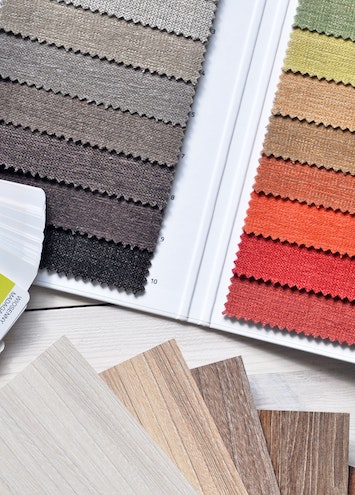
Once the tech-pack is locked, material sourcing begins. This stage is where the most invisible quality decisions are made — and where the gap between a $2.80 cosmetic bag and a $6.50 cosmetic bag is mostly hidden.
The main shell materials we work with daily are PU leather (matte, glossy, pebbled, saffiano, croc-emboss), PVC (clear, frosted, glitter), nylon (210D, 420D, 600D, ripstop), canvas (8oz to 16oz, OEKO-TEX optional), polyester (recycled rPET available), neoprene (2mm and 3mm), satin (for luxury inner pouches), and washable kraft paper for sustainable lines.
Linings deserve the same care as shells. A premium outer with a cheap polyester taffeta lining will feel wrong the moment a customer opens the bag in store. We commonly use 210D polyester, 70D nylon, satin polyester, TPU-coated wipeable lining, and waterproof PEVA for travel toiletry styles.
Lab dips are the most underrated step in the entire process. A brand sends us a Pantone reference; we dye a small swatch in the actual material; we photograph it under D65 daylight and warm tungsten; we ship the physical swatch by international express. Only when the brand signs off on the physical lab dip do we move forward. Skipping lab dips is the single most common reason for bulk-order color disputes.
Hardware is sourced in parallel. Zippers from YKK, SBS or our own quality-equivalent. Sliders custom-engraved with the brand logo. Rivets, D-rings, and feet selected from a library of finishes — gun-metal, antique brass, light gold, matte black, rose gold. For brands building custom cosmetic bag wholesale, hardware customisation is where the product starts to feel uniquely theirs.
4. Stage 3 — Pattern making & first prototype
With materials confirmed, our pattern-making team converts the 2D tech-pack into a 3D paper pattern. This is still done by senior pattern masters, not software alone. CAD plays a supporting role, but a 30-year veteran with a wooden ruler still sees fit issues that software misses — especially around curved zip tracks, gusset depth, and how a bag will "sit" when empty versus full.
The first prototype is cut by hand from the approved materials. It is sewn on a dedicated sampling line by senior sewers who specialise in first runs. A first prototype is intentionally a little rough — the goal is not to look perfect, but to test geometry, proportion, zip path, and overall feel.
We ship the first prototype to the client by international express, usually 7 to 14 days from pattern lock. The client lives with the prototype for a few days, photographs it from every angle, throws it in a handbag, fills it with their actual product, zips it open and closed fifty times, and sends feedback. Almost every first prototype needs revisions. Two to three rounds of revision is the industry norm.
We have seen brands try to skip prototyping in a rush to hit a Q4 launch window. It almost always backfires. The two weeks "saved" at the prototype stage become four weeks of rework at the pre-production sample stage, and sometimes a full re-cut at bulk.
5. Stage 4 — Sample approval & pre-production sample (PPS)
Once the prototype is locked, we produce a pre-production sample — the PPS. The PPS is made with the exact bulk-order materials, the exact hardware, the exact stitching, and the exact branding. It is the contractual reference against which every bulk-produced unit will be inspected.
The PPS is photographed under standardised lighting from twelve angles, weighed, measured against the tech-pack spec sheet, and shipped to the client. Most professional buyers physically sign and date the PPS and ship one signed copy back to us. That signed sample lives in our QC room for the entire bulk production cycle.
For larger programs — typically 5,000 units and up — we recommend a "shipping sample" in addition to the PPS. This is the PPS subjected to a simulated 30-day ocean container journey: humidity cycling, temperature swings, and vibration. It is the closest thing to seeing how the bag will arrive at the client warehouse before bulk is committed.
If your program is complex, you can private label makeup bag case studies showing how the PPS stage played out for brands at different price points.
6. Stage 5 — Bulk cutting
With the PPS signed, the factory floor takes over. Bulk cutting is the first irreversible step in mass production. Once a 200-metre roll of PU is cut, it cannot be uncut. This is why we treat cutting day with the same seriousness as a surgical procedure.
For most material types we use a CNC die-cutting press with custom steel-rule dies made specifically for the order. The die is built from the locked pattern, tested on three layers of sacrificial material, and only then approved for bulk. For very small runs (under 500 units) or very thick materials, hand cutting with a clicker press is more economical.
Cutting efficiency directly drives the unit price. A pattern that nests at 88% material utilisation will be roughly 12% cheaper to produce than the same pattern at 78% utilisation, even with identical materials. This is one of the reasons a good pattern master is worth ten times their salary — they save material on every single bag, every single day.
Every cut piece is bundled by panel type, counted, and matched against the cutting plan. Mis-cut pieces are pulled and replaced before they ever reach the sewing floor. Cutting QC catches roughly 60% of issues that would otherwise reach finished goods.
7. Stage 6 — Printing, embossing & logo decoration
Logo decoration happens after cutting but before sewing. Decorating flat panels is dramatically easier and more consistent than decorating finished bags, so we always decorate at the panel stage whenever possible.
The main decoration methods we run in-house are silk-screen printing (flat or raised), heat-transfer printing for full-colour graphics, debossing (recessed logo with no ink), embossing (raised logo with no ink), hot-stamp foiling (gold, silver, rose-gold, holographic), digital UV printing for short-run customisation, woven labels stitched in, and metal logo plates riveted on.
Each method has its own minimum order quantity logic. Silk-screen pays back its setup cost above 300 units. Heat-transfer is cheaper at 100 units. Metal plates have tooling costs that only amortise above 1,000 units. Choosing the wrong decoration method for the order size is one of the most common ways brands accidentally inflate their unit cost.
For brands that want a luxury feel without luxury MOQ, we frequently recommend combining a debossed primary logo with a small woven label on the inner lining. The combined effect feels premium and works at runs as small as 300 units.
8. Stage 7 — Sewing line & in-line QC
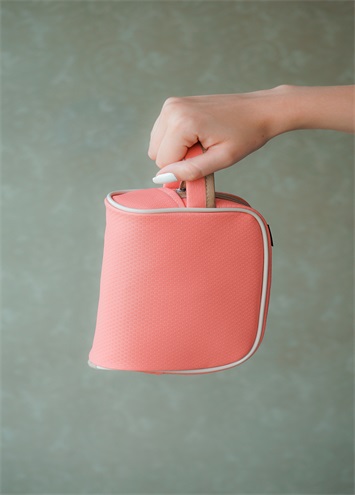
Sewing is where craftsmanship lives. We run dedicated cosmetic-bag sewing lines staffed by sewers with an average of 8+ years on this product category specifically. A sewer who is brilliant at backpacks is not automatically a great cosmetic-bag sewer — the small radius corners, fine top-stitching, and tight zipper tracks of a cosmetic pouch are their own discipline.
Each bag passes through a sequence of 12 to 25 sewing operations depending on complexity. A simple flat pouch may be 12 operations. A structured boxy makeup case with a removable inner tray can reach 25. Each operation is performed by a sewer specialised in that step. This sounds industrial — and it is — but it is what keeps quality consistent across 5,000 or 50,000 units.
In-line QC inspectors sit inside the sewing line, not at the end of it. They check stitch density (typically 8 to 10 stitches per inch for cosmetic bags), corner alignment, zipper symmetry, lining attachment, and binding tape evenness. A defect caught at operation 7 of 25 costs five minutes to fix. The same defect caught after the bag is finished costs the entire bag.
Stitch thread is colour-matched to the shell material under D65 daylight. Bonded nylon thread (Tex 40 or Tex 60) is standard for cosmetic bags — it resists abrasion at the zipper edges where bags fail most often.
9. Stage 8 — Hardware assembly & finishing
With sewing complete, hardware is installed: zipper pulls clipped on, metal logo plates riveted, D-rings and wrist straps attached, feet hammered into structured base panels, and any custom charms or tassels added by hand.
Hardware installation is one of the most under-appreciated stages. A perfectly sewn bag with a misaligned logo plate looks worse than a sloppily sewn bag with perfect hardware. Customers' eyes go straight to the metal. We use rivet-setting jigs to ensure logo plates land within 0.5mm of their spec position on every single unit.
Finishing covers everything else: thread trimming, edge sealing where needed, interior cleaning, and a final wipe-down with a lint-free cloth. For PU and PVC styles, we apply a light anti-static treatment so the bags do not arrive at the client warehouse covered in dust attracted during ocean freight.
10. Stage 9 — Final inspection (AQL 2.5)
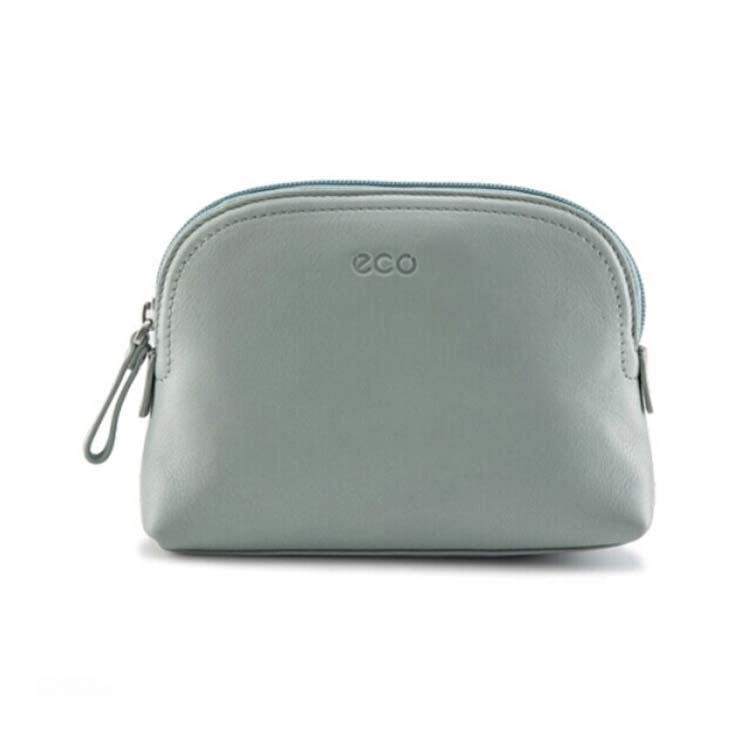
Every order — every single one — goes through final inspection under AQL 2.5 sampling standard before it leaves our facility. For brands unfamiliar with the term: AQL stands for Acceptable Quality Level, and 2.5 is the standard most international beauty buyers require.
Under AQL 2.5, an inspector randomly pulls a statistically determined sample from the finished order. The sample is inspected for major defects (anything that would cause a customer return), minor defects (cosmetic issues that do not affect function), and critical defects (anything unsafe). The number of allowable defects is set by the AQL table relative to the order size.
If the sample passes, the order ships. If it fails, the entire order is 100% re-inspected, defects are reworked or replaced, and a fresh AQL sample is pulled. We will never knowingly ship an order that has not passed AQL 2.5. The cost of replacing a failed batch is enormous — far higher than the cost of doing it right the first time.
For brands selling into highly regulated markets — Sephora, Ulta, Boots, Sasa, Watsons — we can also run AQL 1.5 (stricter) on request. We document every inspection with photos and ship the report to the client by email.
11. Stage 10 — Packing, cartoning & shipping
Packing is the last touch the factory has on the product before it becomes the brand's responsibility. We do not treat it as an afterthought. Bags are stuffed with acid-free tissue to hold their shape, individually polybagged with desiccant for ocean freight, and grouped into inner cartons matched to the client's retail or DC requirements.
Carton specifications are confirmed with the client before bulk: outer dimensions, gross weight under 22kg for retailer compliance, drop-test rating, FSC certification if required, and shipping marks per the client's import broker. For brands shipping into Amazon FBA, we pre-apply FNSKU labels and follow Amazon's carton labelling spec to avoid receiving issues.
For sea freight we work with the client's nominated forwarder or, on request, arrange door-to-door logistics ourselves. For air freight on launch-critical orders, we can split-ship: a small air-freight batch covers the launch event while the main sea freight follows.
12. Lead times: what really drives the calendar
The most common question we hear is "how long will it take?" The honest answer is: it depends on what is in the order. Here is a realistic breakdown for a standard custom cosmetic bag program from briefing to ex-factory.
Briefing and tech-pack lock typically takes 5 to 10 working days. Material sourcing and lab dips take 7 to 14 days. First prototype takes 7 to 14 days. Sample revisions and PPS take 10 to 21 days. Bulk material procurement takes 15 to 25 days (this is the longest single line item and is often invisible to brands). Bulk production takes 25 to 40 days for orders between 1,000 and 10,000 units. Final inspection takes 2 to 4 days.
Total realistic lead time from briefing to ex-factory: 70 to 110 days for first orders. Repeat orders without sample stages can be as fast as 35 to 45 days. We always quote conservative dates and aim to beat them — under-promising and over-delivering is how a 23-year factory stays a 23-year factory.
Brands planning a Q4 holiday launch should ideally lock the tech-pack by April and confirm bulk by June. Brands planning a Q2 spring launch should lock by October of the prior year.
13. MOQ: why factories quote what they quote
Minimum order quantity is one of the most misunderstood numbers in custom manufacturing. Brands often see a 500-unit MOQ as a factory being "difficult." In reality, the MOQ is a function of three real constraints: minimum material rolls, minimum hardware tooling amortisation, and minimum sewing-line setup cost.
A typical PU leather roll is 50 yards. Cutting yield on a small pouch might be 80 pieces per yard. One roll alone produces 4,000 pieces of one panel. Below a certain order size, the factory is forced to either over-purchase material or pay a small-quantity surcharge to the mill — both of which push up unit cost.
For brands starting small, our standard MOQ is 500 units per design and per colourway. For complex constructions with custom hardware tooling, MOQ may rise to 1,000 units. For very simple flat pouches with stock materials, we can sometimes accept 300 units. We are honest about this from the first email rather than baiting brands with unrealistic MOQs we cannot actually fulfil.
14. Common mistakes we see (and how to avoid them)
After more than two decades of working with beauty brands, we see the same five mistakes again and again. The first is skipping lab dips and approving color from a digital JPEG. Screen colour and physical PU colour will never match. Always approve a physical swatch.
The second is choosing material on price alone without testing wear. A 0.4mm PU is 30% cheaper than a 0.7mm PU and looks identical in photos — until month three of customer use, when the cheap one starts to crack. For products selling above $25 retail, do not compromise on shell thickness.
The third is over-engineering the first product. Brands sometimes try to launch with seven internal pockets, three zip compartments, and a removable insert — before they have proof of market fit. A simpler hero bag launched faster usually outsells a complex bag launched late.
The fourth is ignoring the lining. Customers will see and touch the lining every time they open the bag. A cheap lining is the single fastest way to undermine an otherwise premium product.
The fifth is treating the factory as a vendor instead of a partner. The brands we love working with treat our pattern team, QC team, and account managers as part of their extended team. Those are also the brands that scale fastest. OEM cosmetic bag manufacturing services is built around exactly this kind of long-term partnership.
15. FAQ — the questions we answer every week
Q: Do you work with new beauty brands, or only established ones?
A: Both. About 35% of our current client base is brands launching their first product. We have a streamlined onboarding flow specifically for first-time founders, including pattern development from a reference image and step-by-step explanation at every stage.
Q: Can you produce sustainable / eco-friendly cosmetic bags?
A: Yes. We work daily with recycled rPET fabric, OEKO-TEX certified canvas, washable kraft paper, water-based PU coatings, and FSC-certified packaging. We can provide certification documentation for each material on request.
Q: Will you sign an NDA before we share our tech-pack?
A: Yes. We sign mutual NDAs before any sensitive design information is exchanged. Protecting client IP is non-negotiable.
Q: What payment terms do you accept?
A: For first orders, our standard terms are 30% deposit on PO confirmation and 70% balance against a copy of the bill of lading. For repeat clients, we offer extended terms case by case. We accept T/T bank transfer in USD or EUR.
Q: Can we visit the factory?
A: Absolutely. Our Shenzhen facility is open to client visits by appointment. We can also arrange video factory tours for clients who cannot travel.
Q: What is the smallest order you will accept?
A: 300 units for very simple flat pouches with stock materials, 500 units for standard custom programs, 1,000+ units for complex constructions with custom hardware tooling.
16. Talk to our team
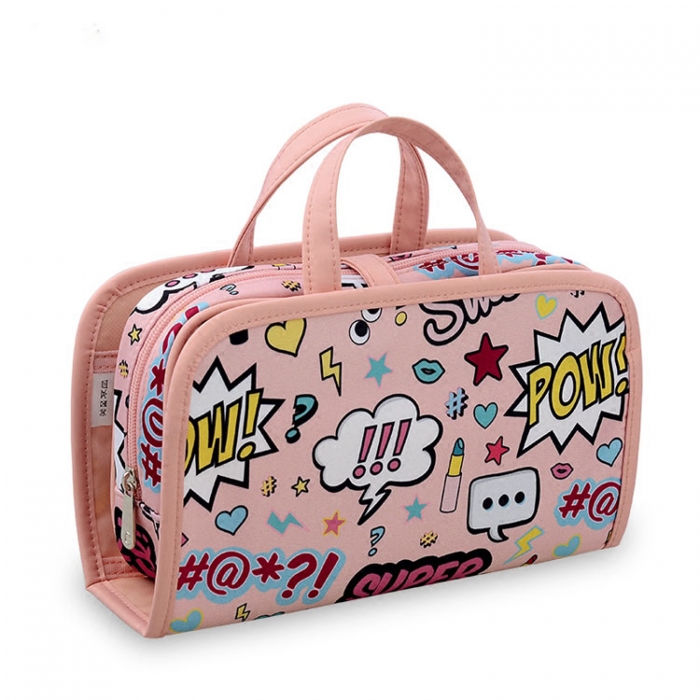
If you are scoping a custom cosmetic bag program for 2026 or 2027, we would be glad to look at your brief, materials wishlist, and target landed cost — and tell you honestly what is realistic and what is not. No long sales calls, no template responses. A real pattern master and a real account manager will look at what you send and reply within one business day.
You can reach our sales team directly at sales002@fuyuanbag.com or message us on WhatsApp at +86 136 9197 5419. If you prefer, send us your tech-pack or a reference image and we will come back with a costing range, lead time estimate, and recommended material spec within 24 hours on a business day.
We have spent 23 years learning how to make a better cosmetic bag. We would love to spend the next chapter making yours.


20+ years focused on cosmetic bags
sales002@fuyuanbag.com
+86-755-21035273
4F No.B, XinTian Innovative Industry Area, GuanLan Street, Baoan District, Shenzhen,Guangdong,China